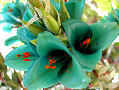
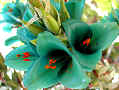
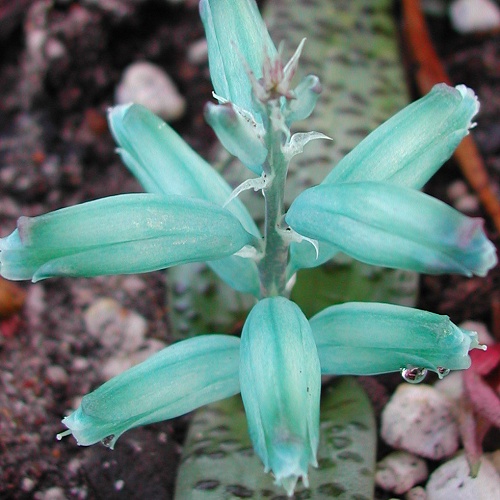
"Turquoise Hyacinth"
Planting the bulbs
When to plant -- Your bulbs will sprout in autumn, so set a reminder to plant them in mid- to late-October (April in the Southern Hemisphere). Until then, store them in a paper bag in a warm spot out of direct sunlight. Or you may plant them in soil before autumn, if the soil can be kept almost completely dry until autumn. Note that they may sprout in autumn even if in a bag, so don't wait too long to plant them. Pot size -- Use a pot at least 4 inches tall (15 cm), and wide enough so each bulb is at least 1 inch (2.5 cm) from the next one, and from the edge of the pot. Use a pot with drainage holes. If you live in a warm-winter area like the tropics, use an oversized, clay pot, to keep the bulbs cooler. Soil -- Use a fast draining soil mix. A typical mix is 1 part
quality potting soil Planting the bulb -- The top of the bulb often is pointier than the bottom, which tends to be flatter and may have dried roots. If you can't tell which end is the top, just plant them sideways and they will straighten themselves out as they grow. Bury them so the top of the bulb is about ½ inch (1-2 cm) deep. In mid-October, water the soil lightly until it is slightly moist throughout (but not saturated), and keep it this moist until they sprout. Until they sprout, keep them between about 48 and 74 degrees F (9-24 degrees C). They should begin sprouting within about 1 to 4 weeks of watering them. Once they sprout, move them to a sunny spot or the equivalent artificial light. Watering -- Keep the soil evenly moist throughout the growing season,
since the root system isn't very deep. Avoid letting it dry out completely, but also
don't keep it constantly saturated or the bulbs could rot. If you're unsure if the soil has the proper
moisture in the root zone, use a
moisture meter Climate -- Throughout winter, it likes temperatures between about 48 and 72 degrees F (9-22 degrees C). Warmer temperatures in winter may make the plants lanky and the flower color might not be as intense. Indoors, you can keep them on the floor of a cooler room. Outdoors, keep them from freezing. Lighting -- They prefer mostly sunny conditions throughout winter & spring. Some afternoon shade may be needed in the lower latitudes such as Florida & Texas, especially in spring, while full sun is best in the higher latitudes. Or keep them 2 inches (5 cm) away from a bright LED light (See: "Growing indoors with LED lights"). Feeding -- This bulb has relatively low fertilizer requirements. Feed about a week after they sprout, and again 2-3 months later. Use an all-purpose fertilizer that contains micronutrients. Feed close to the bulbs, since their root system is small. Avoid feeding after March. Dormancy care -- In spring, the bulbs will begin to die back to prepare for their summer dormancy. Reduce watering during this time, giving just enough water to keep the soil from completely drying out about 2 inches (5 cm) deep). Once the leaves have died back, you may remove the bulbs and store them in a paper bag in a warm spot until autumn.. or just leave them in their pot. Every 2 years, it's good to plant them into fresh soil. Pests to watch for -- Mealy bugs might grow on the bulbs indoors - look for cottony growth on the leaves near the soil, which means the bugs are on the bulb. Try using an insecticidal soap soil drench to kill mealy bugs. Watch for other pests that might affect your other plants. Have fun growing them! - Jeff Strange Wonderful Things
|
|||||||||
 to
2 parts
perlite
to
2 parts
perlite or coarse horticultural sand.
  .
.